or scroll
Prepared for AIM World Services

Deployable
capability,
built on demand.

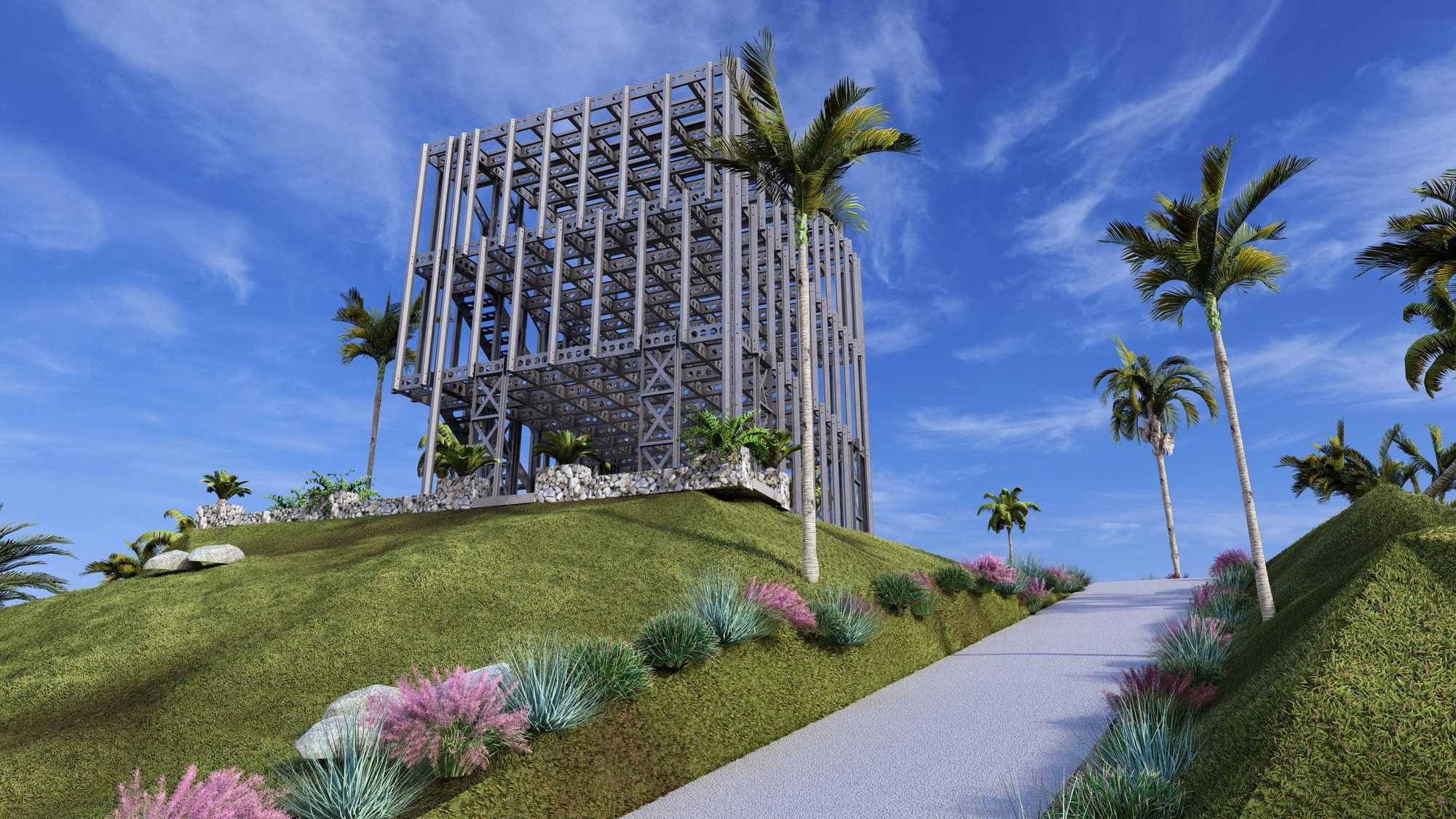
Rockhouse CoGrid is a structural platform engineered for the conditions AIM operates in — disaster zones, remote sites, forward bases. Bolt-together. Crane-free. Unskilled-labour ready.
MH
Prepared for
Mark Hannak — VP, AIM World Services
rhaim.boldagency.com.au
Scan to follow along on your phone
Three-storey CoGrid structure rendered on tropical site
The conditions

AIM goes where conventional construction can't follow.

Disaster relief. Remote workforce camps. Forward operating bases. Government-grade rapid mobilisation. The common denominator: no cranes, limited skilled labour, unforgiving timelines, and zero tolerance for supply-chain fragility.

01

Disaster Relief

Shelters and clinics standing in days, not months.

02

Remote Camps

Workforce housing for resource and infrastructure projects.

03

Military Support

Barracks, mess, command posts, multi-storey compounds.

04

Government

High-tempo procurement with auditable delivery.

The field problem

Every traditional option fails in at least one critical way.

Containerised units

Heavy. Slow to ship. Expensive to move. Fixed footprint.

Modular buildings

Cranes, skilled trades, factory dependency, lengthy lead times.

Local construction

Unpredictable quality. Variable supply. Untrained labour pool.

Shipped prefab

Bulky, fragile, and married to a supply chain you don't control.

AIM doesn't need another building product. AIM needs a deployable system that compresses logistics, labour, and time.

Introducing CoGrid

A structural platform.
Not a house. Not a kit.

CoGrid is a precision-formed steel chassis system that replaces traditional structural complexity with three repeating components. What you build on top is up to the mission.

  • Bolted together — no welding, no specialist trades
  • Ground-level assembly — no cranes, no scaffolding
  • Configurable for any building type, any number of storeys
  • Engineered, tested, patented across major markets
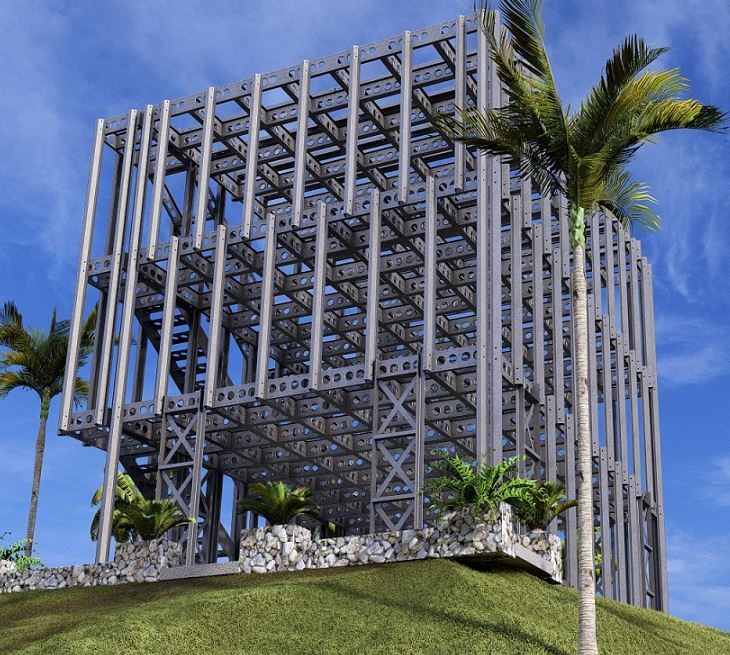
CoGrid steel chassis at multi-storey scale
CoGrid structural chassis · prototype
The whole system

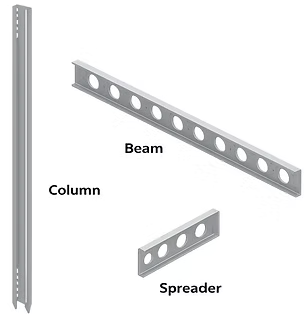
Three components.
All under 16 kg. All bolt together.

01
Columns
Vertical structure · < 16 kg
02
Beams
Horizontal structure · < 16 kg
03
Spreaders
Bracing & load distribution · < 16 kg
Sample CoGrid structure showing the three components
Three components, infinite configurations
Galvanised steel sheet stock — the only input material
Single input: galvanised steel sheet
Priority one · rapid deployment

Built on the ground.
Then jacked into place.

The grid assembles flat and safe at ground level. Floors and roofs are jacked up using the structure itself — no crane in the country, no scaffolding compound, no specialist rigging crew.

  • Repeatable build cycles measured in days
  • Same process for 10 units or 1,000
  • Workable in tight, remote, or post-disaster sites
Grid assembly & Rock-Up concept
Water-jacking system in operation
Lift without a crane

The structure lifts itself.

CoGrid's water-jacking system uses the chassis to raise floors and roofs from below. No crane on critical path. No scaffolding to transport, erect, or insure. Safer for the crew, faster for the programme, and feasible in places a crane could never reach.

  • Removes the single biggest logistics dependency on remote sites
  • Crew works at ground level — drastically reduced fall risk
  • Works the same in a city lot or a flooded floodplain
The labour advantage

If they can hold a wrench, they can build a hospital.

CoGrid is engineered so a small, untrained crew — including local labour, displaced workers, or military personnel — can deliver structurally certified buildings without a trade ticket on site.

  • No welders. No specialist riggers. No formwork carpenters.
  • Components are lightweight enough for two-person handling.
  • Repetitive bolt-together pattern — learned in hours, not weeks.
  • Engineering certainty is in the parts, not the person fitting them.
CoGrid component detail showing simple bolt-together design
Engineered for two hands and a wrench

For AIM, this collapses the single hardest constraint in every remote and disaster deployment: finding people who can build.

Local manufacturing · global standard

The factory comes with you.

CoGrid's automated forming machines are mobile. They can roll into theatre on a flatbed and produce columns, beams, and spreaders from a single input — galvanised steel sheet — already widely available in nearly every market on earth.

  • No dependency on local prefab suppliers
  • No long-distance freight of finished components
  • Components produced at the rate the build crew consumes them
  • One material in. Three components out. Built to spec.
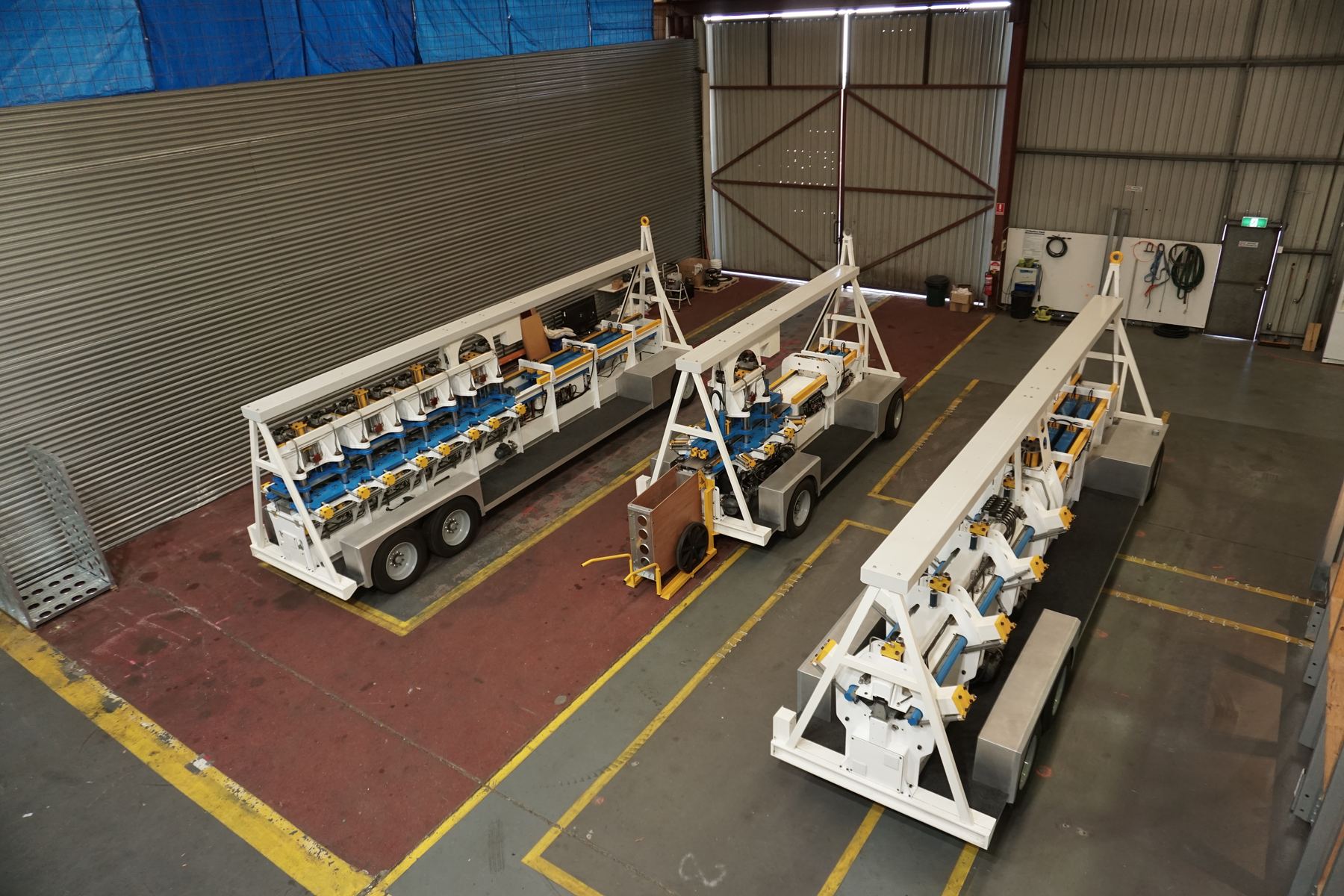
Three CoGrid forming machines staged in workshop
CoGrid forming machines · production unit
Trio of CoGrid forming machines
Beam · Spreader · Column formers
Machines, running

Three machines. One feedstock. Endless components.

Each former runs an automatic cycle. Sheet steel goes in. A finished, bolt-ready CoGrid component comes out. Every time.

Beam Former
Spreader Former
Column Former
Proven engineering

Engineered to be punished.

CoGrid has been physically load-tested by professional engineers and validated against the kind of forces field deployments demand: cyclonic loading, multi-storey loading, and the abuse that comes with rapid build cycles.

  • Independently engineered & structurally validated
  • Patent protected across major markets
  • Multi-storey designs proven at full scale
Structural testing footage
Mission configurable

One platform. Every configuration AIM ships.

The same chassis becomes whatever the mission calls for. Skin it, plumb it, partition it for the use case in front of you — and repeat it across the next site without redesigning.
Barracks Field Clinics Command Posts Mess Halls Workforce Housing Disaster Shelters Multi-Storey Compounds Storage & Logistics Training Facilities
CoGrid configuration example
From components to building

This is what the system actually delivers.

A full two-storey CoGrid house, end to end
Why this works for AIM

Four advantages, stacked.

Logistics

  • Lightweight components
  • Flat-pack transport
  • No oversized loads
  • No crane on critical path

Deployment

  • Ground-level assembly
  • Unskilled-labour compatible
  • Repeatable build cycles
  • Same process at any scale

Scalability

  • 10 units or 1,000 — same system
  • Reusable across deployments
  • Configurable per mission
  • Multi-storey native

Manufacturing

  • Mobile production units
  • Manufacture in theatre
  • Single sheet-steel input
  • No local supply dependency
Where we are honestly

What's proven. What's not — yet.

The system is engineered, machined, patented, and built at full scale once. The next phase is operational: real deployments, in real conditions, with a real partner. That's why this conversation matters.

Proven
  • Engineering & structural performance
  • Manufacturing process & tooling
  • Component design
  • One full prototype house, built
  • Patents secured across major markets
  • Digital platform architecture complete
Not yet proven
  • Multi-unit deployment at scale
  • Cost performance in real projects
  • Logistics performance in field conditions
  • Regulatory approvals across target jurisdictions
  • Partner manufacturing operations
The opportunity for Mark

Not a customer. A co-creator of capability.

AIM is one of the few organisations on earth with the logistics, government access, and operational credibility to validate a new structural system in the field.

  • Shape the first real deployment configuration
  • Define the disaster-relief, military, and remote-housing variants
  • Hold first-mover position in a new infrastructure category
  • Build a capability competitors cannot match
CoGrid configuration in operational context
Capability, configured to mission
The ask

A small pilot. A real site. A documented outcome.

What Rockhouse needs
  • A site
  • A deployment scenario
  • A small AIM team
  • Operational feedback
  • A real-world proving ground

Not money. Not a licence. Not a long-term commitment. A pilot — 5 to 10 units — to validate assembly speed, labour model, logistics, and structural performance under AIM conditions.

What AIM gets
  • First-mover advantage in a new infrastructure category
  • Exclusive early access ahead of any other operator
  • Direct influence on how the system evolves
  • An AIM-specific configuration library
  • A capability story competitors can't tell
Rockhouse CoGrid

Lightweight.
Repeatable.
Ready to deploy.

A deployable structural platform for contingency operations — ready for its first real deployment. AIM is the partner who can make it real.

Prepared by Andrew Heseltine · Rockhouse International
rhaim.boldagency.com.au
Scan to keep this deck on your phone